Designing Security For Deterrence: Why Camera Placement Matters

Updated: Sep 24
Criminal activity targeting open-air assets happens quickly. Theft and vandalism can occur in minutes, often before a traditional security response has time to react. Construction sites alone lose an estimated $300 million to $1 billion annually in stolen equipment, and vehicle-related businesses face similar risks across dealership lots, service centers, and fleet yards.
Recent reports also highlight emerging theft techniques targeting vehicles. In many cases, criminals are using key signal cloning or relay attacks to unlock and steal vehicles remotely, demonstrating how quickly organized theft methods continue to evolve. These risks reinforce the need for proactive deterrence rather than passive monitoring for open-air asset environments such as auto dealerships, equipment rental facilities, construction sites, loading docks, oil and gas sites, utilities, and fleet yards.
The objective of modern security systems should be simple: drive the criminal off the property before theft or vandalism occurs. The same principle applies when someone is scouting a property for a future crime. If the environment presents a clear risk of apprehension or confrontation, the individual will often leave and search for an easier target.
Achieving that outcome requires two things: speed of detection and effectiveness of deterrence. However, many remote video monitoring systems are not designed with deterrence as the primary objective.
Why Traditional Remote Video Monitoring Falls Short
Many remote video monitoring (RVM) providers design systems around a single goal: maximizing visual coverage while minimizing the number of cameras installed.
This approach often relies on long-range cameras mounted high on buildings to view the large open-air areas where vehicles and assets are stored. While this configuration can capture footage, it introduces several significant security limitations leading to missed detections.
Blind Spots Created by Distance
Long-distance camera positioning is more cost-effective; however, it often creates blind spots caused by parked vehicles, construction equipment, trailers, or stored inventory. In environments with constantly changing layouts—such as equipment yards or dealership lots—these blind spots can shift daily.
As a result, an intruder may remain partially or completely hidden from the camera’s field of view, leading to missed detections and allowing criminal activity to occur without consequence.
Monitoring Alone Does Not Stop Crime
Many RVM providers rely primarily on monitoring and police dispatch as their response strategy.
While monitoring can document events and provide useful evidence, it does not necessarily stop the crime from occurring. By the time operators identify the activity and dispatch authorities, the theft or vandalism may already be underway.
Some providers attempt to address this limitation by installing a small number of remote speakers. However, if those speakers are located hundreds of feet away from the trespasser, the deterrence message may be ineffective.
To reliably stop intrusion attempts, security systems must be designed to confront the trespasser immediately and directly. Proximity of the deterrence reaction to the intrusion is often the key to effective deterrence. Consequently, the placement of cameras and deterrence capability (e.g., loudspeakers, strobing police lights, flood lighting, etc.) near the point of intrusion is a critical component of effective security.
Designing Security Systems for Deterrence
Effective deterrence requires more than camera coverage. It requires an integrated system that combines detection, deterrence equipment, and intelligent response configuration.
Three factors determine the success of a deterrence-focused security system:
Equipment
The hardware must support both detection and active deterrence.
Design
The layout of detection and deterrence equipment must account for the property perimeter, likely intrusion paths, and the placement of vehicles or equipment.
Implementation
The system must be configured to respond immediately when intrusion occurs, using deterrence behaviors designed to drive trespassers away.
Security solutions that prioritize these three components are far more effective at preventing criminal activity.
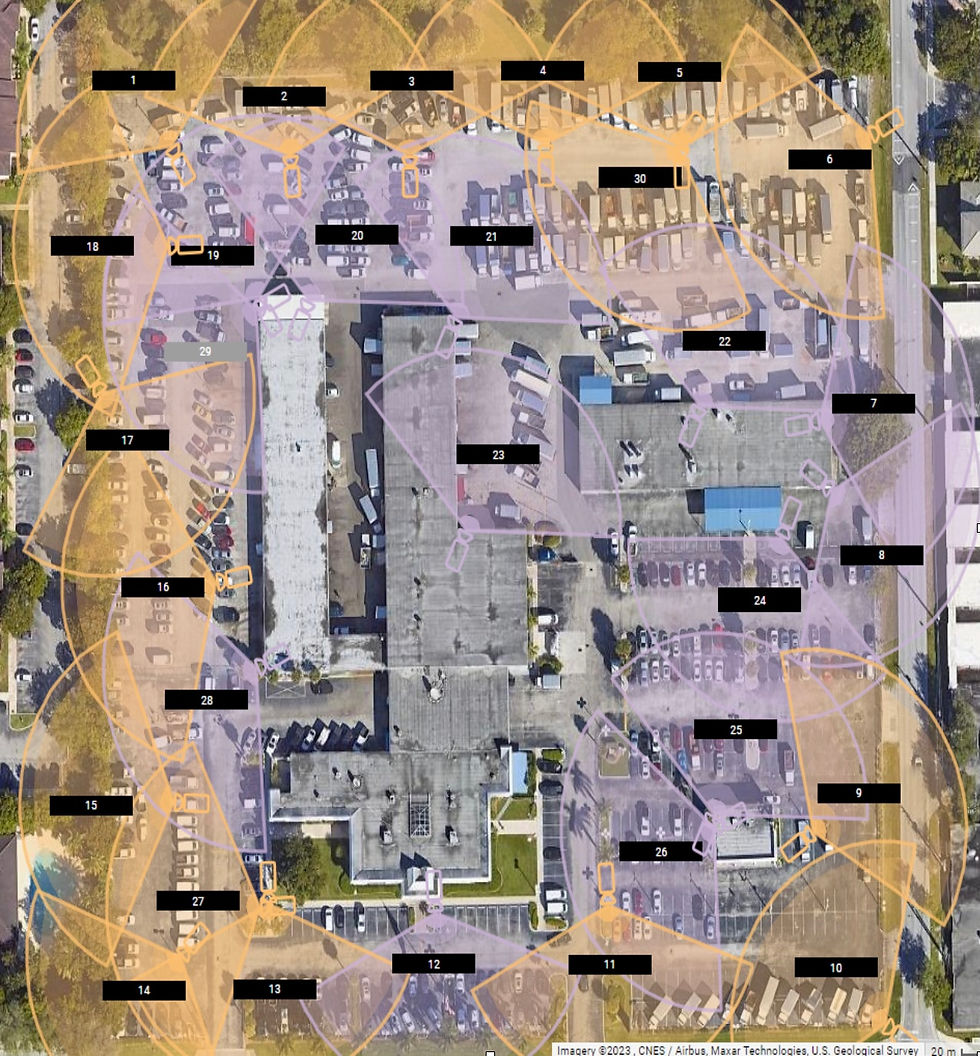
The Importance of Proximity in Deterrence
One of the most important factors in deterrence is proximity to the intruder.
Deterrence actions such as audio warnings, alarms, and strobe lighting are significantly more effective when they occur near the trespasser rather than from a distant location.
When deterrence equipment is positioned close to the intrusion point:
Audio messages are louder and clearer
Alarm tones are more difficult to ignore
Strobe lighting is more visually disruptive
Intruders immediately recognize they have been detected
This immediate confrontation dramatically increases the likelihood that the trespasser leaves the property.
Niō Guardians: Detection and Deterrence in One Device
iDter systems are built around Niō Guardian devices, which combine detection capabilities with active deterrence technology.
Niō Guardians include:
High-intensity flood lighting
Police-style strobe lighting
Three integrated speakers for deterrence messaging
Built-in intelligence for automated detection and response
These devices are typically mounted on light poles or building structures throughout the property.
Rather than relying on a few distant cameras, iDter distributes Niō Guardians strategically across the site. This design protects both the perimeter and the areas where vehicles or equipment are stored.

Because each Niō Guardian is capable of detecting and confronting trespassers, the system creates multiple layers of deterrence across the property.
AI-Driven Detection & Automated Deterrence
The effectiveness of iDter security systems comes from their ability to automatically detect and deter intruders before criminal activity begins.
Artificial Intelligence (AI) analyzes activity across the monitored environment to identify potential intrusion events. When suspicious movement is detected, the system immediately activates deterrence actions.
These responses may include:
Voice warnings
Alarm tones
Strobe lighting
Floodlight activation
The deterrence behaviors are designed to be unpredictable and responsive to environmental conditions, increasing their effectiveness over time.
This rapid automated response plays a significant role in iDter’s performance results. Many properties report up to 98% trespassing elimination after implementing iDter security systems.
Layered Security with Monitoring & Dispatch
While automated deterrence is the first line of defense, iDter also incorporates human monitoring as part of its security architecture.
When an intrusion event occurs:
AI detects suspicious activity.
Niō Guardians activate deterrence responses.
Video monitoring teams verify the event.
Operators can directly engage the intruder if needed.
Authorities are dispatched if the trespasser remains on the property.
This layered approach ensures that automated deterrence is supported by human oversight when escalation becomes necessary.
What to Expect from a Security Provider
Protecting open-air assets requires more than installing cameras. A capable security provider should deliver a complete solution that includes:
Consultation to understand property-specific risks
Security design that distributes detection and deterrence near likely intrusion points
Professional system installation
Ongoing monitoring of the property
Continuous system optimization
Maintenance to ensure maximum uptime
Responsive customer support
A properly designed system should function as a deterrence platform, not just a surveillance tool.
Strategic Security Design With iDter
Open-air assets such as vehicles, construction equipment, and rental inventory are attractive targets for theft and vandalism. Criminals often exploit security systems that prioritize surveillance coverage rather than active deterrence.
By distributing detection and deterrence devices throughout a property, iDter systems confront intruders quickly and decisively. Niō Guardians provide localized lighting, audio, and visual deterrence, while AI detection and monitoring teams ensure that persistent threats are addressed.
The result is a security strategy focused on prevention. Instead of simply documenting crimes after they occur, iDter systems are designed to drive intruders away before damage or theft takes place. For many properties, this approach leads to measurable results, including up to 98% elimination of trespassing incidents. Contact iDter today to learn more about protecting your property and assets with full, effective coverage.


Comments